
Please join me in celebrating the release of the Peace and Conflict Studies Department Visiting Assistant Professor Amy Kapit’s report, “Activism Under Attack: Understanding the Repression of Student Activism.” An interview with the author in the latter half of this blog post sheds light on the thinking put into this report from her perspective.

“One may not immediately think of repression of student activism as a common feature between countries such as the United Kingdom or Zimbabwe, because the political contexts are so vastly different.“
“But this research shows that repression of student activism occurs regardless of how open a society is. So, the use of laws to limit the financing of student unions in the UK and discrediting students by linking them to western imperialism in Zimbabwe are both repressive. It is the means that vary, depending on the socio-political realities and context.“
Press Release: “Attacks on Student Activism Is An Indicator of Democratic Backsliding”
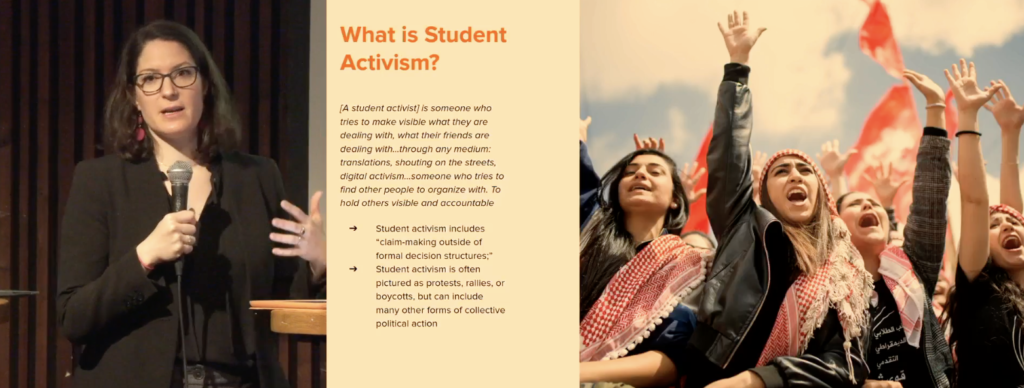
Q1: How has your experience with SAIH and also past experiences working with different organizations and communities (i.e., Swarthmore, NYU, Afghanistan) shaped your works and this report?
It all ends up flowing together. During my Ph.D., I conducted my dissertation research on the origins of a new global movement to protect education from attack. In 2010, a group of organizations, including Human Rights Watch, UNICEF, UNESCO, UNHCR, and NGOs like Save the Children and Education Above All, came together and created a new Global Coalition to Protect Education from Attack (GCPEA) in response to what they saw as a trend of school students and teachers being directly targeted as a tactic of conflict.
For my dissertation research in Palestine, I was interested in investigating how the work on the ground was being affected and shaped in this context of increasing global attention on protecting education. My dissertation research led me to end up working with GCPEA, where I was a Program Officer from 2013 to 2014, and after two and a half years of working on a research project in Afghanistan, I returned back to GCPEA in 2016 as Research Director. During that time, I primarily worked on the report Education Under Attack, which describes attacks on education globally. I focused on developing their methodology for monitoring and reporting these attacks on education. I was mostly concerned with systematizing how organizations collect information on attacks on education.
Then I came to Swarthmore and reflected more critically on that work. In recent years, I’ve become much more interested in interrogating the type of evidence that policymakers value, the evidence that informs decision-making, and questions of who is considered an expert. As a side note, I have recently also published a more reflexive piece with Globalization, Societies, and Education that shows how my thinking about indicators that track attacks on education has changed. Basically, I argue in the piece that constructing global indicators that allow for comparisons across contests means that you lose a lot of the meaning that is important to people’s lives. In order to make things comparable, you have to inevitably simplify reality. In addition, global indicators are political; they are shaped by factors like resources, geopolitics, etc. I argue that, while policymakers want to use these indicators to track progress towards certain goals (for example, the global goal of education for all), the fact that indicators are simplifications of reality reduces their transformative potential.
This brings me to my more recent work. Along the lines of what I was just saying–that we live in an era of “evidence-based” decision-making–the Norwegian Students’ and Academics’ International Assistance Fund (SAIH) reached out to me about a year ago because they were interested in highlighting the repression faced by university student activists and in generating more data to strengthen their advocacy. I was familiar with SAIH because they had been a partner of GCPEA when I worked there. They reached out to me in the hope of developing a methodology to track and report the repression of student activism. In many ways, my perspective on evidence-based decision-making aligns with SAIH’s worldview. They’re a solidarity organization created during the anti-apartheid movement whose motto is “education for liberation” and takes inspiration from the work of Paolo Friere. We thought working together was a good match.
For this first report, I primarily focused on the first step of constructing that methodology by starting with defining the issue. In this first report, we interviewed students and human rights advocates, who were mostly NGO staff members, to understand what kinds of actors they understand as forms of repression. Ultimately, though, I think this understanding needs to come from the students themselves. So interviewing students is one of our next steps.
Q2. What was your initial thought when you started this report? Why the focus on student activism, and what was the thought process like when connecting the case studies?
SAIH pinpointed the focus, but one that interested me. It is not something that I have worked on that much in the past.
In terms of the case studies conducted in different countries, one of the things that myself and my partner I at SAIH were interested in understanding was whether global indexes ranking things like civic participation and academic freedom reflected what the people we spoke with said about how much space for student activism existed in their own contexts. So I started by looking at a couple of V-Dem indexes. First, the Participatory Democracy Index measures and ranks countries according to how much space there is for civic action. Then there is also the Academic Freedom Index, which is supposed to apply to students. I ended up using the Academic Freedom Index to select countries. The Index ranks countries into five categories according to their levels of academic freedom. I selected two countries from each band with the goal of trying to understand differences in the presence of repression and the mechanisms of repression at each level.
Three Swarthmore students, Brandon Archer, J Choi, and Crystal Secaira, worked with me as research assistants to develop the database of repressive events. Based on this work, we concluded that repression occurs regardless of how open or closed and that the index does not fully tell us what repression looks like or how it’s happening; which connects to the quote in the beginning.