

Join us for the Peace and Conflict Studies Department’s Spring 2025 Film Series on Wednesday evenings between April 9th and April 30th. Our four films will explore how imperialism, militarism, and police states are normalized through Hollywood and television, who benefits and is harmed by the military industrial complex from the Cold War to the so-called “War on Terror,” and how violence can be confronted productively. We’ll serve dinner, start the films five minutes later, and save time afterwards to unpack them.
We strongly recommend reading Love in Action by Thích Nhất Hạnh, but there won’t be a quiz. Please contact Professor Wilson-Becerril at mwilson5@swarthmore.edu with any inquiries or accessibility requests.
Dinner will be provided on a first-come, first-served basis. The room reservation is Science Center room 199.
Theaters of War (2022), 87 minutes – April 9 (5:00-7:00 p.m.)
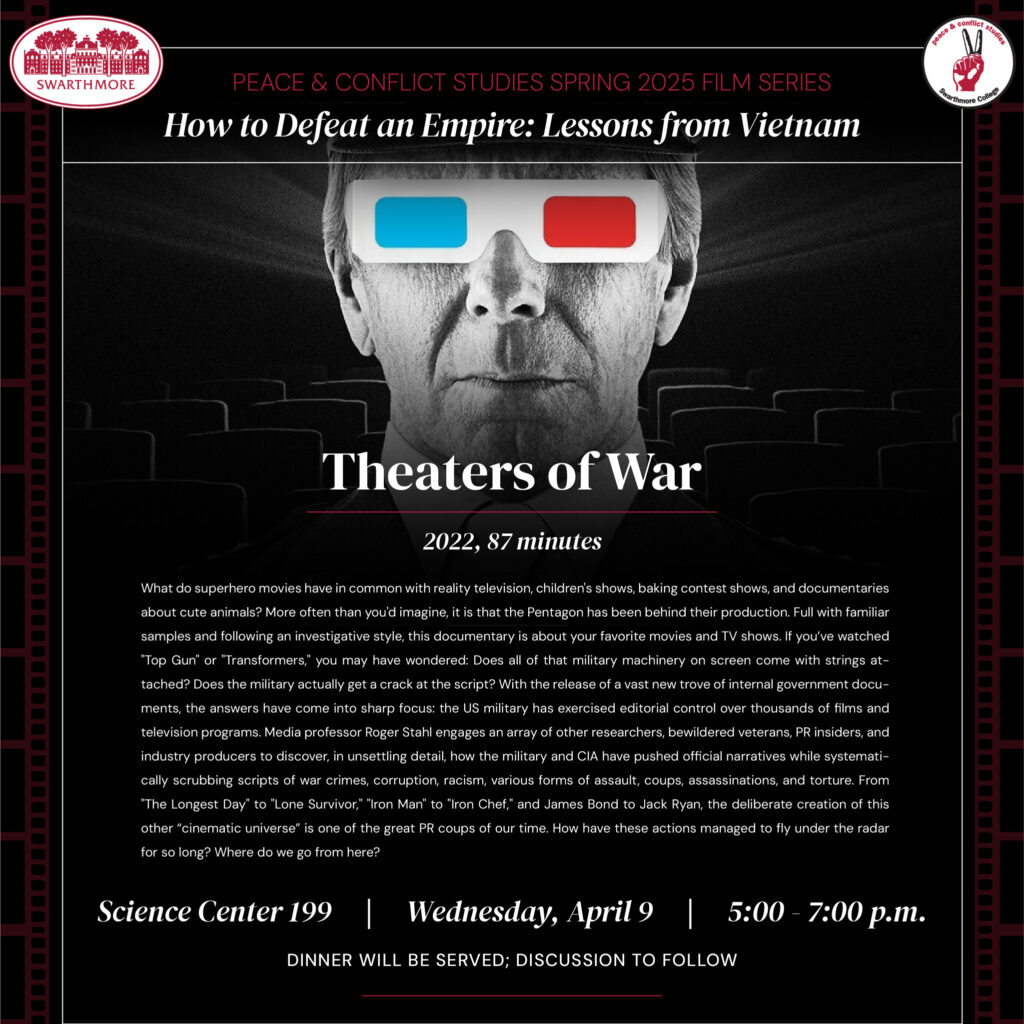
What do superhero movies have in common with reality television, children’s shows, baking contest shows, and documentaries about cute animals? More often than you’d imagine, it is that the Pentagon has been behind their production. Full with familiar samples and following an investigative style, this documentary is about your favorite movies and TV shows. If you’ve watched “Top Gun” or “Transformers,” you may have wondered: Does all of that military machinery on screen come with strings attached? Does the military actually get a crack at the script? With the release of a vast new trove of internal government documents, the answers have come into sharp focus: the US military has exercised editorial control over thousands of films and television programs. Media professor Roger Stahl engages an array of other researchers, bewildered veterans, PR insiders, and industry producers to discover, in unsettling detail, how the military and CIA have pushed official narratives while systematically scrubbing scripts of war crimes, corruption, racism, various forms of assault, coups, assassinations, and torture. From “The Longest Day” to “Lone Survivor,” “Iron Man” to “Iron Chef,” and James Bond to Jack Ryan, the deliberate creation of this other “cinematic universe” is one of the great PR coups of our time. How have these actions managed to fly under the radar for so long? Where do we go from here?
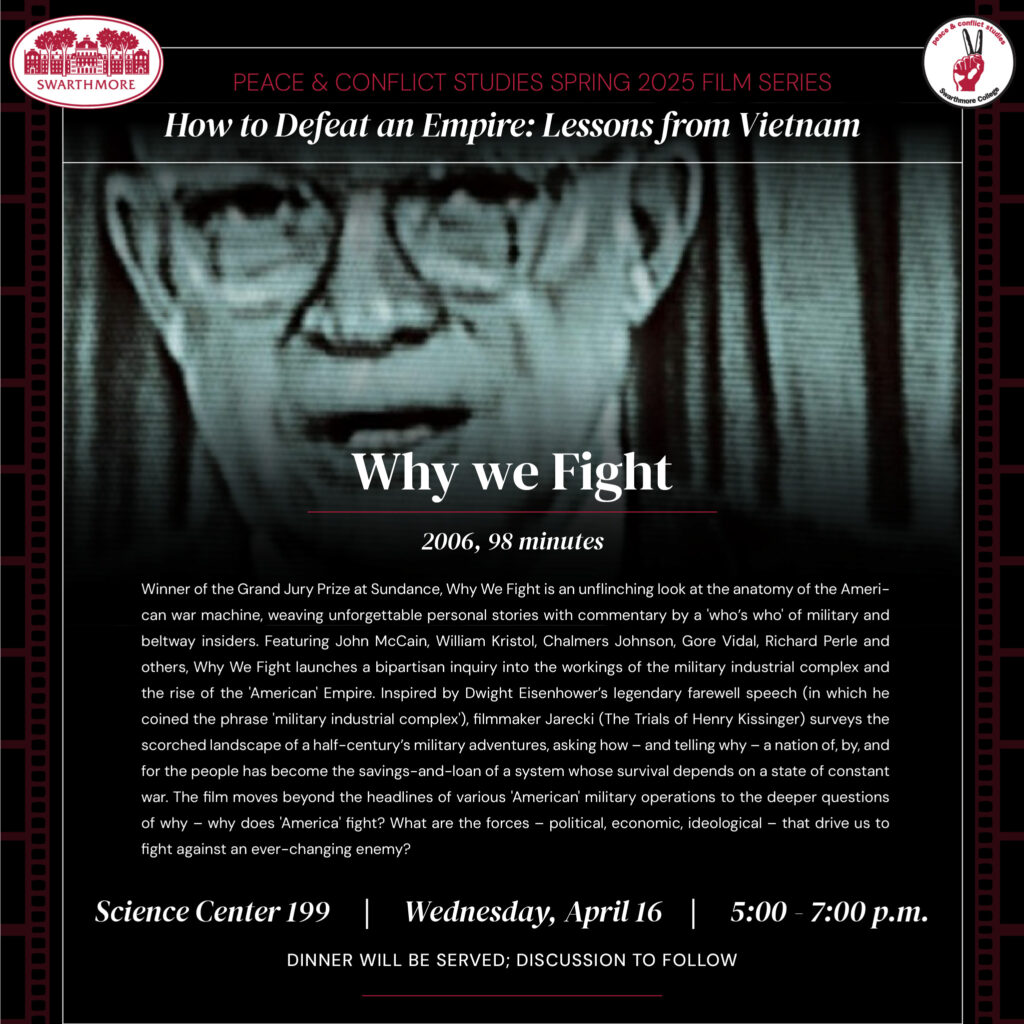
Why We Fight (2006), 98 minutes – April 16 (5:00-7:00 p.m.)
Winner of the Grand Jury Prize at Sundance, Why We Fight is an unflinching look at the anatomy of the American war machine, weaving unforgettable personal stories with commentary by a ‘who’s who’ of military and beltway insiders. Featuring John McCain, William Kristol, Chalmers Johnson, Gore Vidal, Richard Perle and others, Why We Fight launches a bipartisan inquiry into the workings of the military industrial complex and the rise of the ‘American’ Empire. Inspired by Dwight Eisenhower’s legendary farewell speech (in which he coined the phrase ‘military industrial complex’), filmmaker Jarecki (The Trials of Henry Kissinger) surveys the scorched landscape of a half-century’s military adventures, asking how – and telling why – a nation of, by, and for the people has become the savings-and-loan of a system whose survival depends on a state of constant war. The film moves beyond the headlines of various ‘American’ military operations to the deeper questions of why – why does ‘America’ fight? What are the forces – political, economic, ideological – that drive us to fight against an ever-changing enemy?
The Fog of War (2003), 127 minutes – April 23 (5:00-7:30 p.m.)
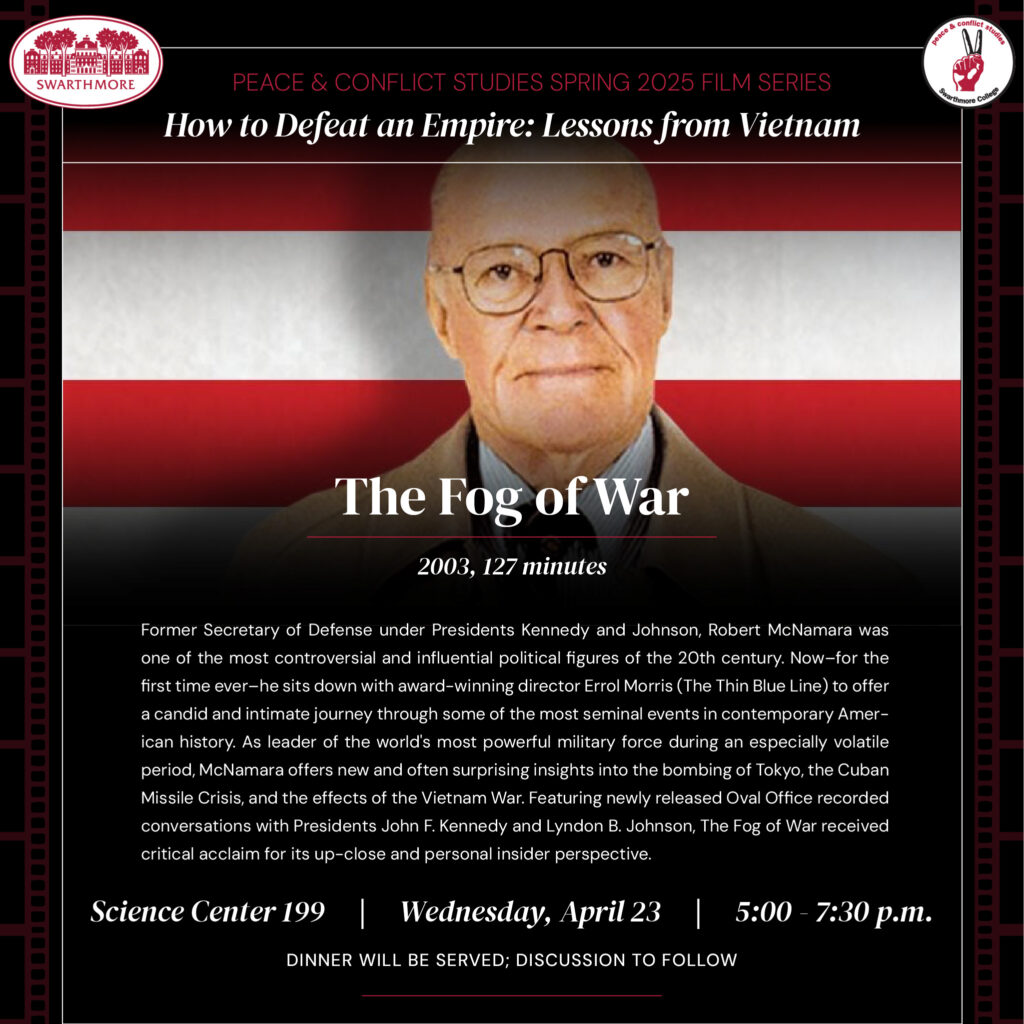
Former Secretary of Defense under Presidents Kennedy and Johnson, Robert McNamara was one of the most controversial and influential political figures of the 20th century. Now–for the first time ever–he sits down with award-winning director Errol Morris (The Thin Blue Line) to offer a candid and intimate journey through some of the most seminal events in contemporary American history. As leader of the world’s most powerful military force during an especially volatile period, McNamara offers new and often surprising insights into the bombing of Tokyo, the Cuban Missile Crisis, and the effects of the Vietnam War. Featuring newly released Oval Office recorded conversations with Presidents John F. Kennedy and Lyndon B. Johnson, The Fog of War received critical acclaim for its up-close and personal insider perspective.
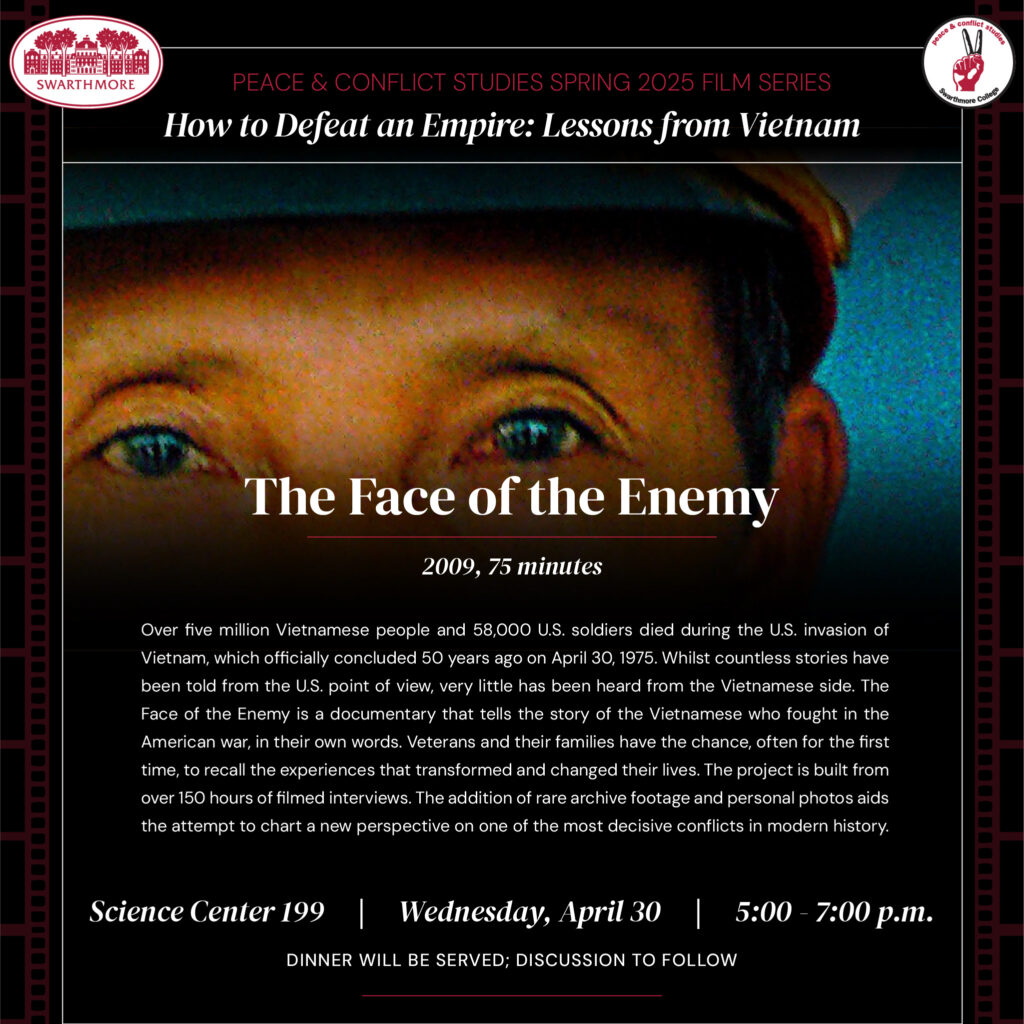
The Face of the Enemy (2009), 75 minutes – April 30 (5:00-7:00 p.m.)
Over five million Vietnamese people and 58,000 U.S. soldiers died during the U.S. invasion of Vietnam, which officially concluded 50 years ago on April 30, 1975. Whilst countless stories have been told from the U.S. point of view, very little has been heard from the Vietnamese side. The Face of the Enemy is a documentary that tells the story of the Vietnamese who fought in the American war, in their own words. Veterans and their families have the chance, often for the first time, to recall the experiences that transformed and changed their lives. The project is built from over 150 hours of filmed interviews. The addition of rare archive footage and personal photos aids the attempt to chart a new perspective on one of the most decisive conflicts in modern history.