
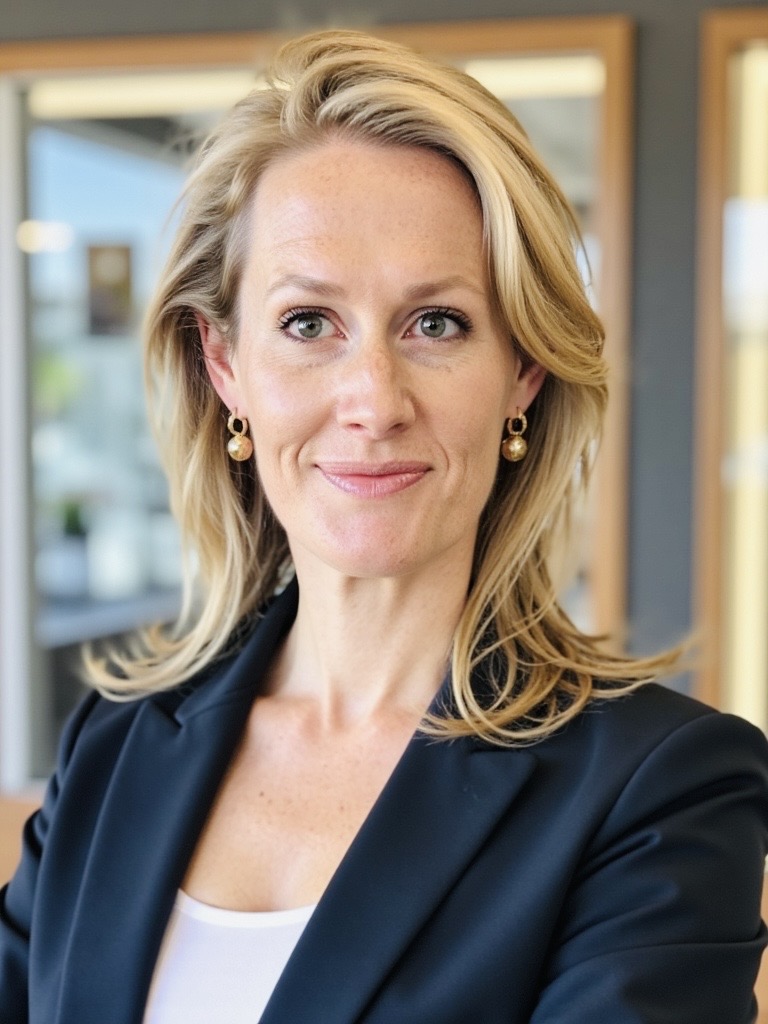
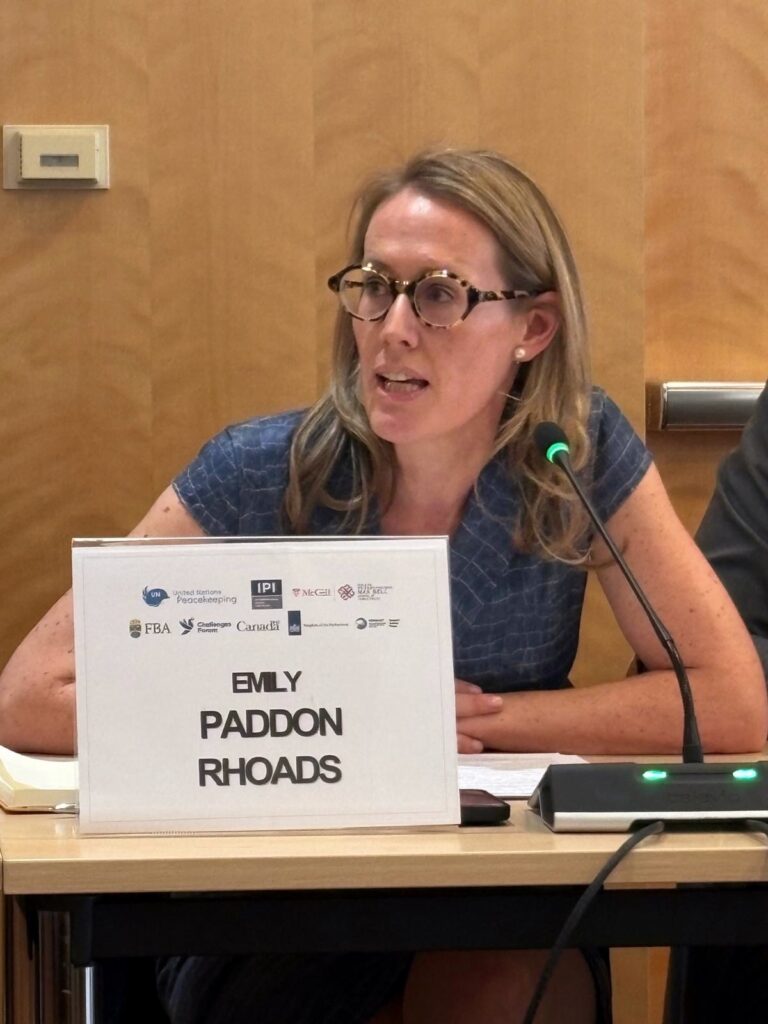
Associate Professor of Political Science at Swarthmore College, and a member of the Department of Peace and Conflict Studies’ faculty committee.
Peace and Conflict Studies became a full department in 2022, but Swarthmore’s engagement with the discipline reaches back to 1888, when the College taught the first-ever peace studies course in American higher education. What follows is a conversation with one of the scholars who carry on that legacy today.
1. Her work
Professor Emily Paddon Rhoads did not always know she wanted to be an academic. When she began her graduate studies in International Relations, a career in policy or as a practitioner in the field were equally possible. In the end, what tipped her toward academia was a combination of two things: a passion for research, and a love of teaching she discovered at Oxford. In the years since, her focus has steadily expanded from the institutions that govern conflict to the people those institutions are meant to protect.
“A lot of my work — what animates it, I would say — is a deep curiosity about vulnerability and the uneven ways in which people are protected from it, including how they protect themselves.”
2. Protection across scales
Her first book, Taking Sides in Peacekeeping: Impartiality and the Future of the United Nations (Oxford, 2016), examines how transformations in armed conflict and civilian protection mandates have reshaped the meaning and practice of impartiality in UN peacekeeping operations. Her later work increasingly focused on questions of civilian self-protection and protective agency. She co-edited Civilian Protective Agency in Violent Settings (Oxford, 2023), a volume that helped establish a new field of inquiry into how civilians and communities navigate protection and survival amid violence.
What changed in the questions you were asking?
“The institutions I was studying, which were very top-down, weren’t starting with the question of how people protect themselves. What emerged was not a departure from institutional questions, but a broader understanding of protection as negotiated across scales, from international organizations to frontline communities.”
She traces this turn to a 2012 paper she co-authored with the Canadian scholar Erin Baines, on civilian self-protection responses to the Lord’s Resistance Army in northern Uganda and DRC, arguing that those responses had to be understood on their own terms. The research and edited volume that followed were, she says, “an attempt to define the field and bring together scholars working across disciplinary and sub-field silos.” That kind of border-crossing has been a constant throughout her career:
“I’ve never been especially interested in staying within neat intellectual boundaries. The questions that matter most to me tend to pull me across them.”
She is also unromantic about her own subject:
“Some forms of self-protection and civilian protective agency can actually entail threats to oneself and also to others. So it is important not to be Pollyannish about civilian protection.”
A more recent strand of her work follows civilians into the digital domain:
“About five years ago, I became really interested in the question of technology, in the context of Syria — how civilians and frontline local actors use technology to support self-protection and help overcome collective-action problems, but also the ways it introduces new threats: mis- and disinformation, surveillance, and new forms of visibility and exposure.”
And the field you work in: what state is it in?
“We’ve seen a real shift from a moment of confidence — and, I think, misplaced faith — in international intervention to one of deep uncertainty and backlash. The 1990s were defined by widely accepted beliefs that external actors could stabilize conflict. Today we face fragmented conflicts, contested authority, and a global response infrastructure under severe strain. Multilateralism is weaker and mandates are increasingly contested.”
3. Fieldwork
Prof. Paddon Rhoads’s own thinking made the same kind of turn: earlier, and on the ground, in eastern Congo and South Sudan.
“It was in grad school, when I started doing grounded research in conflict-affected settings, that I realized this is the work I want to do. It’s in these settings that some of the most important questions about power and protection and responsibility come to light.”
The way she approaches this work has also changed over time. Today, it often involves shorter trips, shaped in part by the realities of teaching and raising three children, alongside deeper partnerships with researchers and practitioners in the places she studies. The shift is not simply methodological but ethical:
“I have built out more extensive partnerships and collaborations with people in the contexts I’m working, not instrumentally, but as something integral to the work itself. That kind of partnership keeps me accountable to what matters most and to the deeper questions animating the work.”
How do you think about fieldwork now?
“I do not think of it simply as ‘the field,’ but as being in the world in a serious and accountable way. It is where many of the most important questions emerge.”
“Earlier in my career, I may have thought of fieldwork primarily as a method for gathering evidence. Increasingly, I see it as a practice of listening, relationship-building, and intellectual humility.”
What does fieldwork teach that institutional study can’t?
“It teaches how protection is actually experienced rather than merely theorized. It reveals how trust is built, strained, and repaired under pressure. It shows how people exercise agency even in dire conditions not of their choosing. And it humbles tidy assumptions that can survive too easily in abstract debate and distance.”
4. At Swarthmore
For roughly a decade, Prof. Paddon Rhoads has served on the faculty committee of the Department of Peace and Conflict Studies (PCS) at Swarthmore. When asked what the community here has meant to her, she answered at length:
“The PCS community has been a deeply formative part of my experience at Swarthmore. My home department is Political Science, which has also been an important intellectual home for me, and the combination of Political Science and PCS has given me a rich and meaningful scholarly home: one where rigorous inquiry, ethical seriousness, human concern, and engagement with the world reinforce one another.”
“What I have valued most, ultimately, is the people. That is what I return to first.”
That community is “not only intellectually serious, but often animated by a desire to contribute meaningfully beyond themselves” — what she calls “sharpness and generosity.”
For her, the department’s recent Peace and Justice Studies Association Conference at Swarthmore was a milestone, “a beautiful expression of this community at its best, convening thoughtful people across fields and institutions in service of urgent questions.”
5. Teaching
Prof. Paddon Rhoads’s teaching and her research are not separate enterprises. Last fall, her Syrian collaborator Muzna Dureid — a former White Helmet and co-founder of the Syrian Women’s Political Movement — spent a week at Swarthmore and co-taught two of her classes, a visit that came, she notes, “on the heels of my visit with [Dureid] to Damascus in the spring.” She has also brought students to the UN in New York, visiting the Security Council and General Assembly, and she regularly brings practitioners and collaborators into conversation with them on campus.
What has teaching come to mean to you?
“Teaching, at its best, is relational work. You offer tools, challenge, and care, and sometimes you have the privilege of witnessing someone discover more fully who they are and what they might contribute. There is no real substitute for that. And in the process, the teacher is changed, too.”
“I care deeply about rigor, both analytically and ethically. I want students to become careful analytic thinkers who can weigh evidence, challenge assumptions, write clearly, and engage complexity without retreating into easy answers.”
Her teaching has evolved, she says, in a direction “both more demanding and more humane,” toward an ever-deeper appreciation of “the power of meeting students where they are, and of the role care plays in intellectual growth.” She describes mentorship as “helping students see more fully their own capacities, widening their sense of what may be possible for them, and supporting them as they move toward it” — work she conducts through advising, conversation, and the Rubin Mentorship Program. What stays with her are moments like these:
“You see students recognize that ideas travel outward, that the world is more reachable than it sometimes seems, and that they themselves already have something meaningful to contribute.”
6. What’s over the horizon
Her most recent work is beginning to carry the civilian-agency framework she built in conflict zones to the United States.
“This work is still very nascent. It expands what I’ve looked at in civilian agency and protective action to grassroots protection and resilience more broadly, in response to compound crises. That has taken me, here at Swarthmore, through the HEARD Initiative, into a small pilot in the U.S. on mutual-aid responses to disasters.”
Alongside this, she continues to examine questions of institutional values and legitimacy under conditions of uncertainty, across both international and local contexts, in ongoing dialogue with policy and practitioner communities.
Asked what is ultimately at stake for the future of research and higher education, she points back to her years at Oxford:
“You had your meals in college, and you never knew who you were going to sit down next to at dinner — an anthropologist, a medical biologist, an international legal scholar. There was a baked-in assumption of interest and curiosity.”
She finds something of that spirit at Swarthmore. More broadly, however, she sees the conditions that sustain it under pressure. “Those structures are breaking down,” she says. “We need those generative spaces.”
“I think it’s where the stakes are enormous— the questions before us about technology and AI. How do we create and protect spaces that cultivate real rigor of thought, openness to complexity, uncertainty, and engagement with difference? I wouldn’t limit it just in terms of interdisciplinarity.
“I think there’s actually something much more fundamental and epistemic at the core of that. And I think sometimes institutions just say, well, we do interdisciplinarity, as though that’s the silver bullet that actually encompasses all these things.”
The Department of Peace and Conflict Studies at Swarthmore describes its work as “a dynamic interplay between research, education, and action.” Professor Emily Paddon Rhoads illustrates exactly that interplay in her work: a researcher who focuses on the dynamics of protection across global and local institutions, communities, and individuals; a teacher who fell in love with teaching; and a scholar in deep conversation with the policy world.
Drawn from a March 2026 video conversation and an April 2026 email exchange, with light editing for clarity in conversation with Prof. Paddon Rhoads.